
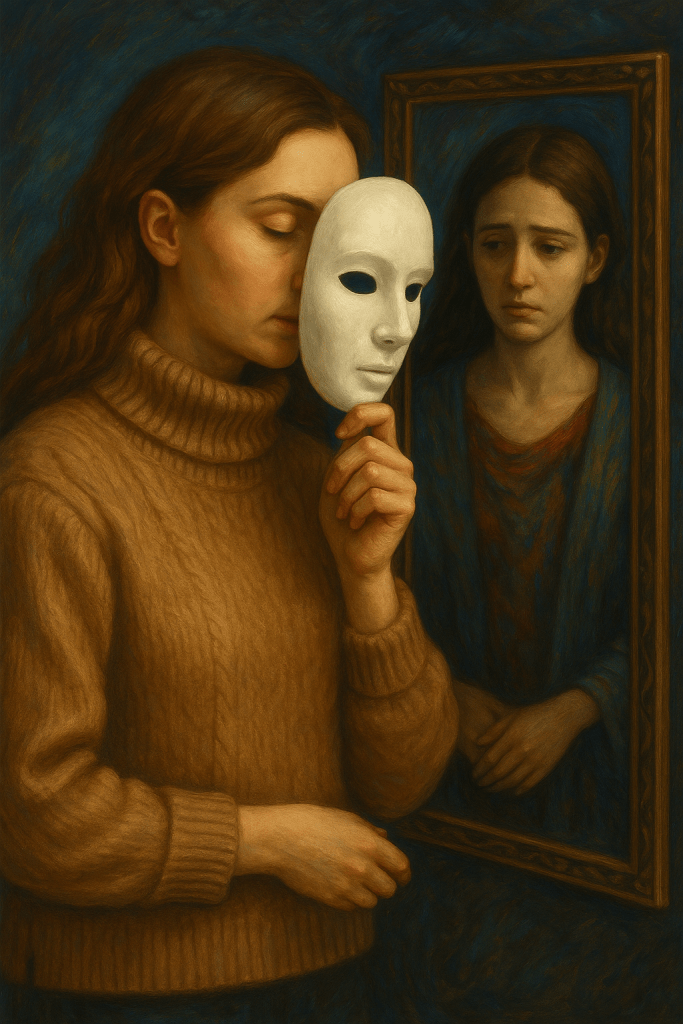
We live in a world where being human feels like a silent crime.
We tiptoe through our lives, terrified of our own existence — afraid of making a sound, of being seen, of saying the wrong thing. We hide our bodies as if they are secrets. We censor our thoughts to avoid offending. We pretend we’re perfect, rehearsing smiles and smoothing out the edges of our personalities, terrified of being labeled “too much.”
But here’s the irony — in this desperate attempt to be loved, we forget how to love ourselves. We fear our flaws, but we’re told to “be authentic.” We’re shamed for our desires, but we’re expected to “be confident.” We’re pulled in every direction by a society that whispers contradictions — be bold, but not too bold. Be real, but not too real.
So we perform. We become experts at wearing masks, tailoring our personalities to fit the room, the crowd, the moment. We hide our truths in polite smiles, our fears behind forced laughter. We apologize for our existence in subtle ways — muting our laughter, holding in tears, walking with our shoulders hunched.
But why? Why are we so afraid of living honestly?
Maybe it’s because we’ve been taught that being human is a thing to overcome rather than embrace. That to be flawed, awkward, or vulnerable is to be weak. That the raw parts of us — the messy, unfiltered, deeply human parts — are something to be ashamed of.
But what if we’ve been lied to?
What if our rawness is our beauty? What if the very thing we hide — our imperfect, trembling, passionate humanity — is what connects us?
And what would life look like if we dared to live it without apology?
This is an exploration of that fear — the fear of living honestly — and the journey of reclaiming our right to simply be human.
Table of Contents:
- Section 1: The Fear of Authenticity
- Section 2: Shame and the Stigma of Imperfection
- Section 3: Living in a World of Fear
- Section 4: The Mask We Wear
- Section 5: Breaking Free: Embracing Our Humanity
- Conclusion
Section 1:
The Fear of Authenticity
We’ve been trained to edit ourselves.
Not just our thoughts, but our very being — like a raw gemstone chipped away until it’s polished and safe to touch. We say what we think others want to hear. We smile even when we’re hurting. We avoid the messy truth in favor of the polished lie.
It starts early. As children, we’re taught to be polite, to fit in, to avoid making waves. “Don’t be too loud.” “Don’t talk back.” “Don’t be weird.” And so we learn the art of masking — of being acceptable rather than being real.
But here’s the cost — when we hide our true selves, we become strangers to ourselves. We deny our needs, our dreams, our truth. We become a performance, a reflection of expectations rather than an expression of our souls.
Authenticity is terrifying because it means being seen — truly seen. And being seen means risking rejection, criticism, even ridicule. It means speaking our truths even if our voices shake. It means embracing our quirks, our mistakes, our unfiltered thoughts.
But what if we let go of that fear?
But let’s be honest — when was the last time you laughed at someone else’s embarrassment? When did you last judge someone’s awkwardness or failure? And more importantly, when was the last time you did it to yourself?
How often do you become your own worst critic, belittling your own thoughts, your appearance, your abilities?
Do you even know yourself? Beyond the mask, beyond the performance — do you know the raw, unfiltered, brilliantly flawed human you are?
What if you dared to meet them?
Authenticity is not perfection. It’s the freedom to be flawed, to be awkward, to be brilliantly, beautifully human.
Section 2:
Shame and the Stigma of Imperfection
We are taught to fear our flaws.
From the moment we can understand, we are told what is “ugly,” “inappropriate,” or “embarrassing.” We learn to hide our stretch marks, our acne, our awkwardness. We are taught to measure ourselves against impossible standards — flawless skin, perfect bodies, effortless confidence.
But perfection is a mirage. A shimmering lie we chase but never reach.
And yet, we shame ourselves for falling short. We criticize our bodies in the mirror, replay our mistakes in our minds, and judge ourselves more harshly than we ever would another. Our inner voice becomes an unrelenting critic, whispering that we are never enough.
But why do we do this?
Because we have been trained to believe that being imperfect is the same as being unworthy. That our humanity is something to overcome rather than something to embrace.
But what if the very things we hide — the scars, the quirks, the awkward laughs — are what make us beautiful? What if we stopped apologizing for our humanity and started honoring it?
Wanting a magazine cover body or a celebrity face isn’t necessarily a bad thing. I’m not here to shame desires or trying to achieve different goals that aren’t my own. But it’s important to notice your intention.
Ask yourself, am I acting from criticism or fear? Or am I acting from self-love and authentic desire?
When was the last time you looked at yourself without judgment?
When was the last time you spoke to yourself with kindness?
What would happen if you dared to accept your imperfections as proof of your humanity?
Section 3:
Living in a World of Fear
Fear is a shadow that follows us everywhere.
We live in a world where danger is constantly whispered in our ears. The news cycles endlessly feed us stories of violence, disaster, and chaos. We are taught to fear strangers, fear the unknown, fear rejection, fear failure. Our minds become crowded with worry — not just for our safety, but for our survival.
We fear not having enough money. We fear looking poor. We fear being seen as different. We fear the judgment of others, the sting of embarrassment, the shame of failure.
But it goes even deeper than that.
We fear walking down the street alone. We fear the possibility of mass shootings, of random violence, of being in the wrong place at the wrong time. Politics feel like battlegrounds, and we hold our breath wondering what new law or event will threaten our safety, our freedom, or our sense of belonging. It’s not just in our heads — the world has always been a scary place. The difference now is how accessible that fear has become. We carry it in our pockets. We scroll through it every day.
This isn’t a call to ignore reality. Being informed is important. Staying aware is necessary. But drowning in fear doesn’t make us safer — it makes us smaller. There’s a difference between awareness and paralysis. And when fear is used as a tool of control, it becomes even more dangerous.
We’re taught we need control to be secure — over our surroundings, our outcomes, even our own mortality. And because of that, fear tactics work. They make us feel powerless unless we act, unless we obey, unless we constantly stay afraid.
And then there’s the fear of death — the great unknown we rarely talk about unless it’s to avoid it. In many Eastern cultures, especially in Chinese and other Asian traditions, death is accepted as part of the cycle. It’s not hidden or denied — it’s embraced, respected, and understood. But in the modern Western world, we treat death like a failure. We dread aging. We fear illness. We’re taught to push those ideas away, to cling to youth and health as if they’re the only acceptable states of being.
Even modern medicine, for all its miracles, is often pushed with a heavy undercurrent of fear. Commercials speak in the language of threats — what might happen if you don’t act, what dangers are lurking in your body right now. It’s easy to forget that healing is not just a clinical process — it’s also emotional, spiritual, and deeply human.
So we carry all this weight — fear of living, fear of dying, fear of being out of control.
But what if this fear is a lie?
What if the world is not as hostile as we’ve been taught? What if our vulnerabilities are our strengths? What if the courage to live boldly — to be honest, to be flawed, to be human — is the key to true freedom?
When was the last time you lived without fear?
When was the last time you dared to take up space, to speak your truth, to love without holding back?
Fear may always be there. But it doesn’t have to be the voice that guides your life.
And maybe that’s the root of it all — the loss of control. We fear death, and we fear being seen, because we can’t control them. We fear what we can’t predict. We fear what we can’t fix.
But control is an illusion, and life was never meant to be a perfectly manicured experience. Maybe peace doesn’t come from gaining control — maybe it comes from releasing it.
Section 4:
The Mask We Wear
Most of us don’t even realize we’re wearing a mask — until it starts to crack.
We craft these identities so carefully. We become the version of ourselves we think the world will love. We shape-shift to fit the room, shrink to stay safe, speak only the parts of our truth that won’t rock the boat. And it works — for a while.
We get praise, acceptance, maybe even admiration. But behind it all, we start to feel hollow. Because deep down, we know the version of us the world sees isn’t the whole truth.
We wear masks to protect ourselves from pain. But they also block us from connection.
How many times have you laughed when you really wanted to cry? How often have you said, “I’m fine,” when you were falling apart inside? We become so used to hiding that vulnerability starts to feel like danger.
And social media only deepens the performance. We curate our lives into highlight reels, polishing our presence until it no longer resembles reality. We scroll through a thousand versions of perfection and wonder why we feel like we’re failing.
But the thing about masks is that they get heavy. And eventually, they start to suffocate us.
Wearing a mask might help you fit in, but it will never help you feel free.
So ask yourself: Who are you when no one’s watching? Who are you when you’re not trying to be liked, admired, or approved of?
What would your life look like if you stopped performing and started living?
True connection doesn’t come from being perfect. It comes from being real. And the moment you take off the mask — even just a little — you give others permission to do the same.
Let yourself be seen.
For me, I was raised wearing a mask — so much so, I didn’t even realize it was there. It wasn’t until I started peeling it back that I began to see how often others wear theirs too. Suddenly, I noticed it everywhere. I’d hear friends or family say things like, “I had something in my teeth? How embarrassing,” or “I tripped walking the dog the other day — people definitely saw me. So embarrassing.”
Even when something small would happen — like me dropping something in the grocery store — they’d laugh in that exaggerated way, trying to curve the tension: “Oh no! You just dropped something! I hope no one saw!”
And it hit me. Embarrassment isn’t always about the moment — it’s about the mask slipping. It’s about being seen without the filter we’ve worked so hard to maintain.
The truth is, you can make people uncomfortable just by being undeniably yourself — especially if they haven’t faced their own reflection yet.
Another version of this? When you share a story that’s a little vulnerable and the energy shifts — it suddenly feels like you overshared. But the truth is, you didn’t. They just weren’t ready to receive it.
And that’s not a reflection of you — it’s a reflection of where they are with themselves.
Section 5:
Breaking Free: Embracing Our Humanity
There comes a moment — sometimes quietly, sometimes all at once — when we realize we’re tired. Tired of hiding. Tired of shrinking. Tired of living half-truths.
And in that moment, something shifts.
We begin to crave something real. Not polished. Not curated. Just honest. Something that feels like home within ourselves.
Breaking free doesn’t mean becoming someone new — it means finally returning to who you’ve always been underneath the noise.
It means allowing yourself to laugh without checking who’s watching. It means speaking your truth even when your voice trembles. It means choosing softness in a world that tells you to harden.
It’s in the messy middle — the awkward laugh, the genuine tears, the moments that don’t fit neatly into a post — that we find freedom.
To embrace our humanity is to reject the belief that we must be perfect to be loved, or polished to be worthy.
It’s a rebellion against fear, and a celebration of truth.
So breathe.
Let yourself be clumsy, emotional, loud, quiet, unsure, growing. Let yourself be human.
You weren’t born to perform. You were born to live.
And every time you choose honesty over performance, softness over perfection, and presence over fear — you break the cycle.
You free yourself.
And that freedom… it’s contagious.
For me, I took mushrooms to feel my mask — and breaking free from it was a revelation. I’m still working on it, honestly. But I wouldn’t trade the awareness for anything.
Figuring out where to start can be overwhelming and intimidating. And once you do start, there will be moments when the mask slips back on. You might notice it and feel frustrated, like you’ve taken a step backward.
But here’s what I’ve learned: every moment of awareness is progress. Even if the mask comes back, next time you might catch it sooner. You’ll learn how to peel back the layers of old stories and step into your truth, again and again.
If you’re wondering where to begin, start with a mirror. Look at your face, your body. Make silly faces. Smile at yourself. Dance. Let yourself be seen — by you. Then, get curious. What makes you happy? What feels like joy in your body? Try new things. Step out of your comfort zone. Explore shadow work. Connect with your inner child — swing on the swings, eat ice cream without needing a reason. Let it be genuine, not performative. Not to be liked. Just to be you.
Personally, I choose not to support shame or embarrassment. If I do something “embarrassing,” I laugh with love. I shrug it off. I remind myself, “I’ve done worse,” just to silence that old menacing voice.
That’s the truth of breaking free: not perfection, but presence.
Not reinvention — just returning to the self you’ve always been.
Conclusion
So here we are — a little messy, a little unsure, but still showing up. Still breathing. Still human.
There’s no manual for how to do this perfectly, because perfect isn’t the goal. Real is. Honest is. Alive is.
If you’ve made it this far, I hope something within you feels seen — or at least a little less alone. I hope you know that being human isn’t something to hide. It’s something to honor.
You don’t have to wait until you’ve healed everything, figured everything out, or reached some polished version of yourself to be worthy of love, connection, and freedom.
You’re worthy right now. As you are. In this moment.
So laugh too loud. Cry when it hits. Speak even when your voice shakes. Let your presence be imperfect and beautiful.
Because maybe the most radical thing we can do in a world that teaches us to hide — is to let ourselves be human.
And in doing that, we give others permission to do the same.
Let’s stop performing.
Let’s start living.
Thank you for being here on this journey with me! I would love to hear from you and your thoughts. Drop a comment or reach out!
Blessings, friends.
 Divine Events
Leave a comment